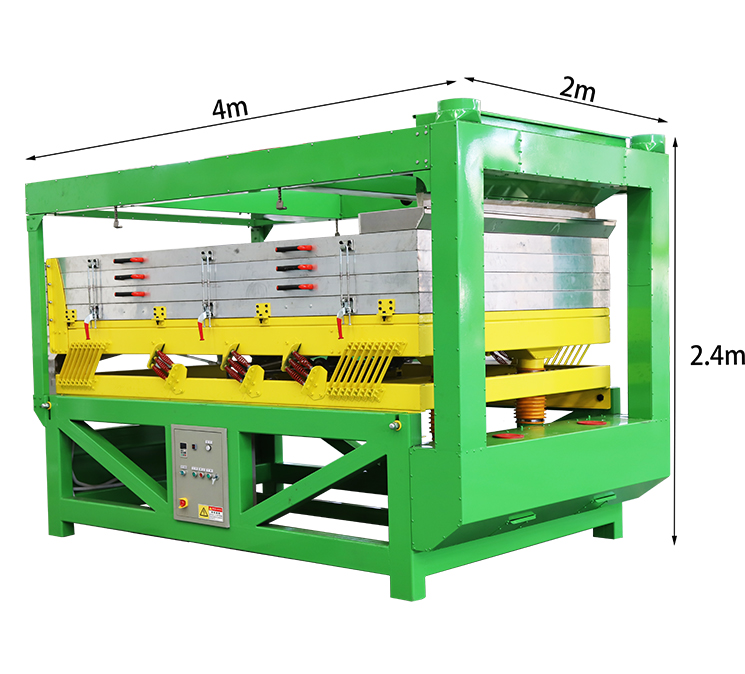
The mesh size of the pull rod vibrating screen has a significant impact on the screening effect, mainly reflected in the following aspects:
1、 Screening accuracy
1. Mesh size: The mesh size in the sieve specifications directly determines the particle size of the material that can pass through the sieve. The smaller the sieve aperture, the finer the particle size of the material that can be screened, and the higher the screening accuracy. On the contrary, the larger the sieve aperture, the coarser the particle size of the screened material, and the corresponding screening accuracy decreases.
2. Grading effect: In a multi-layer sieve structure, the size of the sieve holes varies at different levels, allowing for graded screening of materials. This graded screening method can significantly improve the accuracy of screening and effectively separate materials of different particle sizes.
2、 Screening efficiency
1. Processing capacity: The size of the sieve mesh will also affect the processing capacity of the rod vibration sieve. Within a certain range, the larger the sieve aperture, the larger the open area of the sieve surface, and the faster the material passes through the sieve, thereby improving the screening efficiency. However, if the sieve holes are too large, it may cause a large amount of fine-grained materials to pass through the sieve, reducing the screening accuracy.
2. Screen utilization rate: Reasonable screen specifications can improve the utilization rate of the screen, reduce the accumulation and blockage of materials on the screen, and enable materials to pass through the screen more smoothly, thereby improving screening efficiency.
3、 Mesh material and durability
1. Material selection: The material of the sieve can also affect the screening effect. High strength and wear-resistant screen surface materials, such as polyurethane and steel wire mesh, can extend the service life of the screen surface while ensuring the screening effect. For some corrosive materials, corrosion-resistant screen materials such as stainless steel mesh can be chosen.
2. Durability: The durability of the sieve directly affects the continuity and stability of the screening process. Durable screens can reduce the frequency of screen replacement, lower maintenance costs, and ensure the stability and consistency of screening performance.
4、 Adaptability
1. Material characteristics: Different materials have different properties, such as particle size distribution, humidity, viscosity, etc. Reasonable screen specifications can better adapt to the screening needs of different materials and improve screening efficiency.
2. Adjustment of operating parameters: In practical applications, it is necessary to adjust the operating parameters such as excitation frequency and amplitude according to the characteristics of the material and screening requirements to achieve better screening results.
In summary, the mesh size of the rod vibration sieve has a significant impact on the screening effect. When selecting screen specifications, it is necessary to comprehensively consider factors such as screening accuracy, screening efficiency, screen material and durability, and adaptability to meet specific screening needs.