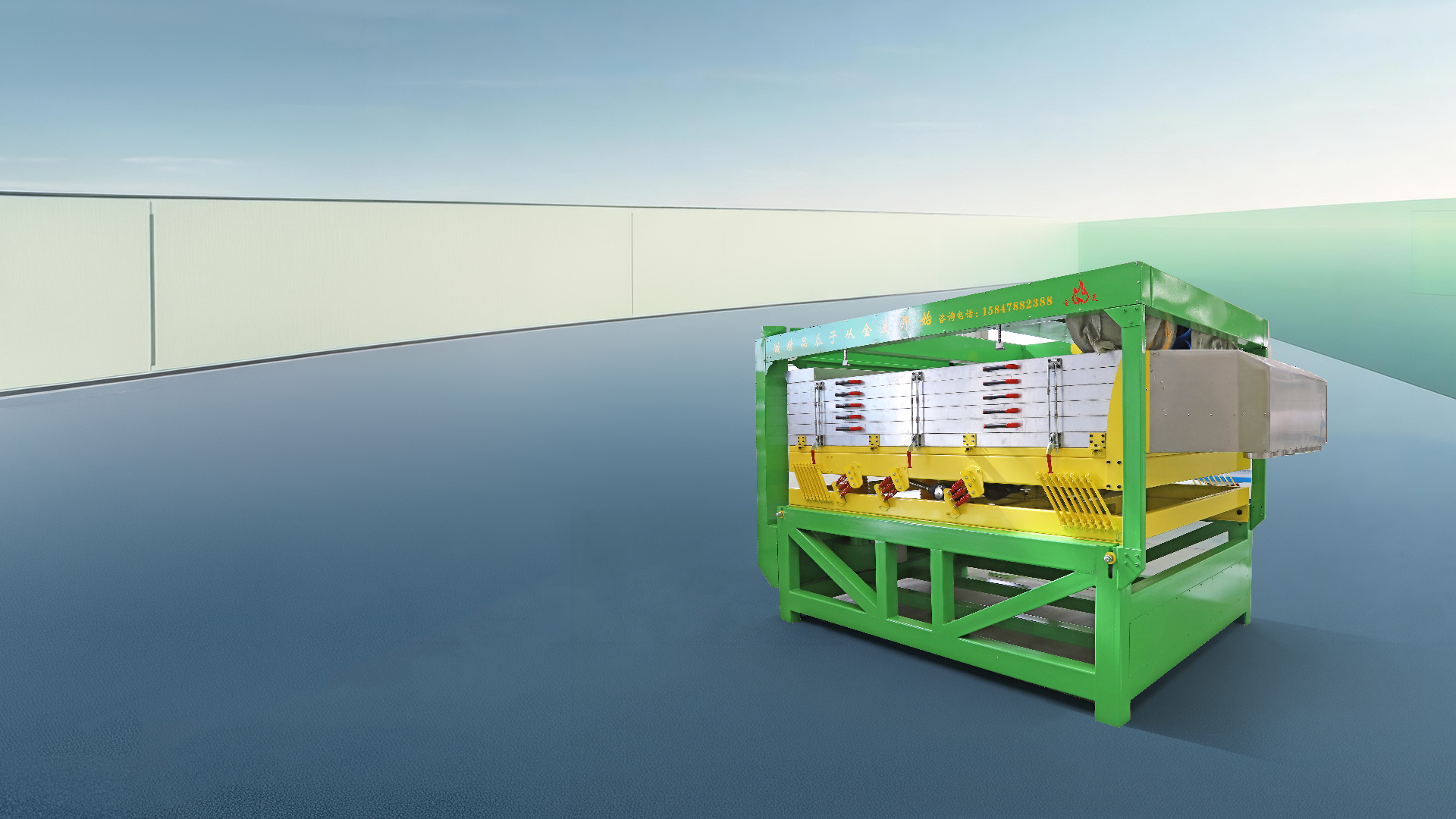

Our company's pull rod excitation screen is based on the general linear vibrating screen, but with the screen frame material changed to aluminum alloy, making the screen body lighter and more portable.
The rod-excited screen features a compact structure, low energy consumption, and low noise, achieving a screening efficiency of up to 99%. The screen mesh has a long service life, the screen segments are easy to replace, and the material does not get stuck; it boasts good sealing
performance, with minimal dust emission. The rod-excited screen utilizes an eccentric rod structure connected by spring segments as the vibration source, causing the material to be thrown up on the screen mesh while moving forward linearly. The material enters the feeder of the screening machine uniformly through multiple layers of screen mesh, producing several specifications of oversize and undersize materials, which are discharged from their respective outlets. During the relative motion between the material particles and the reciprocating vibrating screen surface, the particles contact the screen surface and, if their projections completely enter the screen holes during the motion, pass through the holes, achieving the purpose of separating particles of different sizes. The rod-excited screen has advantages such as low power consumption and high output.