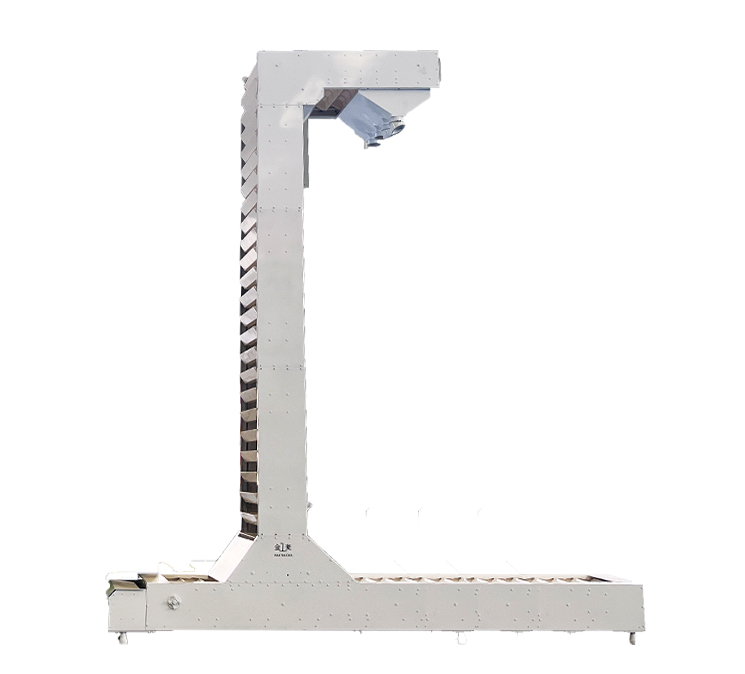
To prevent hopper detachment and deformation faults in non crushing elevators (taking bucket elevators as an example), the following measures can be taken:
1、 Prevent hopper detachment failure
1. Tighten bolts in stages
When installing for the first time, tighten the connecting bolts between the hopper and the chain, run it without load for 2-4 hours, and immediately tighten it again after stopping.
After one week of formal feeding operation, tighten the bolts again.
After running continuously for one month, check the bolts for the third time and tighten them.
By tightening in stages, initial looseness caused by vibration can be eliminated.
2. Adopting anti loosening measures
For high load conditions, welding can be used to spot weld the nut and screw interface after tightening the bolt to prevent thread retraction. This method has low cost and significant effect, but attention should be paid to welding strength to avoid affecting bolt disassembly.
Replace ordinary bolts with anti loosening and anti retreat bolts, using mechanical principles to resist vibration and reduce manual maintenance frequency, suitable for situations where frequent maintenance is inconvenient.
3. Regular inspection and maintenance
Include bolt inspection in the daily checklist of the equipment bucket elevator, and tighten it comprehensively at least once every quarter.
Observe whether the bolts are deformed or worn, and replace inferior parts in a timely manner.
Check if the connection between the hopper and the chain is loose, and tighten it promptly if there is any looseness.
2、 Prevent hopper deformation failure
1. Add a toothed hopper
When the material clumps, a toothed hopper can be installed every 10 hoppers in the bucket elevator.
The flat mouth at the front of the hopper can be changed to a Z shape to break it when the hardness of the board layer is not too high, allowing the subsequent hopper to take out the crushed material.
2. Add reinforcing bars
Add reinforcing ribs between the front and rear panels of the hopper to improve its overall strength.
This method can avoid severe deformation caused by insufficient strength of the hopper during stacking.
3. Reasonably design the hopper structure
When designing a hopper, the characteristics and conveying requirements of the material should be fully considered, and the appropriate hopper shape and material should be selected.
Ensure that the hopper has sufficient strength and rigidity to withstand the tension of materials and chains, as well as vibrations and impacts during operation.
4. Avoid adding gaskets
Try not to install washers when installing bolts, as the wear of washers can easily increase the distance between the chain and the hopper, resulting in inconsistent wear of the sprocket and deformation of the hopper.
In summary, by tightening bolts in stages, implementing anti loosening measures, conducting regular inspections and maintenance, and adding toothed hoppers and reinforcing ribs, it is possible to effectively prevent hopper detachment and deformation faults in non crushing elevators. The implementation of these measures will help improve the stability and service life of the equipment, ensuring the smooth progress of the production process.