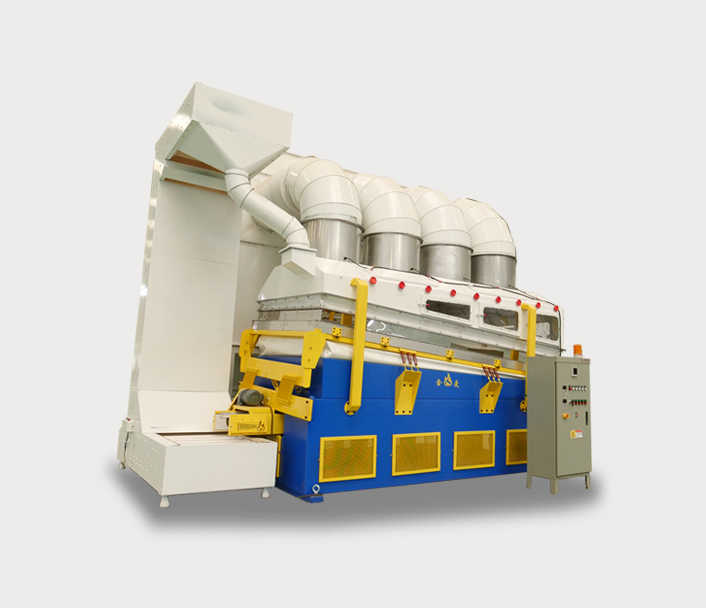
As an efficient material sorting device, the working principle of the negative pressure specific gravity machine relies on the synergistic effect of "negative pressure adsorption force" and "material specific gravity difference", combined with vibration fluidization technology, to achieve precise separation of materials of different qualities. This principle revolves around three key steps: material stratification, airflow screening, and directional export, fully utilizing differences in physical properties to achieve sorting objectives. The following provides a detailed analysis based on the equipment operation logic.
The fluidization and specific gravity stratification of materials are the fundamental steps in sorting. After the equipment is started, the body generates a specific frequency of vibration through the vibration device. When the material enters the screen surface from the feeding port, the vibration force will break the static state between the material particles, making the particles in a suspended and loose fluidized state. At this point, materials with different densities will naturally stratify due to the combined effect of gravity and vibration: materials with higher densities (such as plump seeds and intact particles) will be more affected by gravity and quickly settle to the lower layer of the screen surface, closely adhering to the screen surface to obtain the kinetic energy transmitted by vibration; Impurities with low specific gravity, such as deflated particles, insect infested particles, and light dust, are suspended in the upper layer of the material layer and are easily driven by airflow. This layering phenomenon provides a prerequisite for subsequent airflow screening, ensuring clear separation interfaces for materials of different qualities.
Negative pressure adsorption and directional screening are the core steps in sorting. The equipment forms a stable negative pressure environment through the top exhaust system, and the airflow penetrates from below the screen surface upwards, producing differentiated forces on materials of different densities when passing through the material layer. For light impurities suspended on the surface, their gravity is less than the adsorption force generated by negative pressure airflow, and they will be adsorbed upwards by the airflow, and then guided to the waste collection area through the air guide channel; The heavy materials in the lower layer, whose gravity is greater than the adsorption force of the airflow, will not be carried away by the airflow, but will instead move in the designated direction along the sieve surface under vibration. The special design of the sieve surface (such as long strip holes and inclined angles) further enhances the sorting effect: the sieve holes ensure smooth airflow and prevent heavy materials from falling off. At the same time, the inclined angle, combined with vibration, drives heavy materials to move towards the discharge port, achieving preliminary separation of light and heavy materials.
Secondary sorting and precise purification are key supplements to improving sorting accuracy. Some negative pressure specific gravity machines are equipped with a graded screening structure. After the initial separation of materials, there may still be a small amount of partially separated mixed materials (such as semi full particles and heavier impurities), which will be guided to the mixing outlet. The equipment sends the mixed material back to the feed inlet through the return device, and undergoes the process of fluidization stratification and negative pressure screening again, achieving secondary or even multiple sorting. At the same time, the equipment can adapt to the characteristics of different materials (such as particle size, humidity, and degree of density difference) by adjusting parameters such as negative pressure intensity, vibration frequency, and screen angle, ensuring that both subtle density differences and complex material combinations can achieve ideal sorting results. This adjustability and secondary sorting design greatly improve the sorting accuracy and applicability of the equipment.
Airflow circulation and impurity collection are important guarantees for the implementation of the principle. The negative pressure system not only adsorbs light impurities, but also introduces the airflow and impurities into the dust collection device. After filtration treatment, the clean airflow can be recycled or discharged in compliance with standards, avoiding dust diffusion and environmental pollution. This design not only meets environmental requirements, but also reduces airflow loss and ensures the stability of negative pressure environment. The collected impurities are centrally discharged through the waste outlet, and the genuine materials are screened and exported from the dedicated outlet, ultimately completing the complete sorting process of "raw material input layering screening purification finished product output".
In summary, the working principle of the negative pressure specific gravity machine is essentially based on the physical action chain of "vibration promotes stratification, negative pressure selects light and heavy, and circulation improves accuracy". It does not rely on chemical reagents and can achieve efficient material sorting through mechanical vibration and airflow control alone. The core logic lies in amplifying the difference in specific gravity of different materials, utilizing the synergistic effect of fluidization and negative pressure adsorption to form an orderly sorting force through gravity, vibration, and airflow, ultimately achieving precise separation of high-quality materials and impurities. It is widely used in seed processing, agricultural and sideline product purification, and other scenarios.