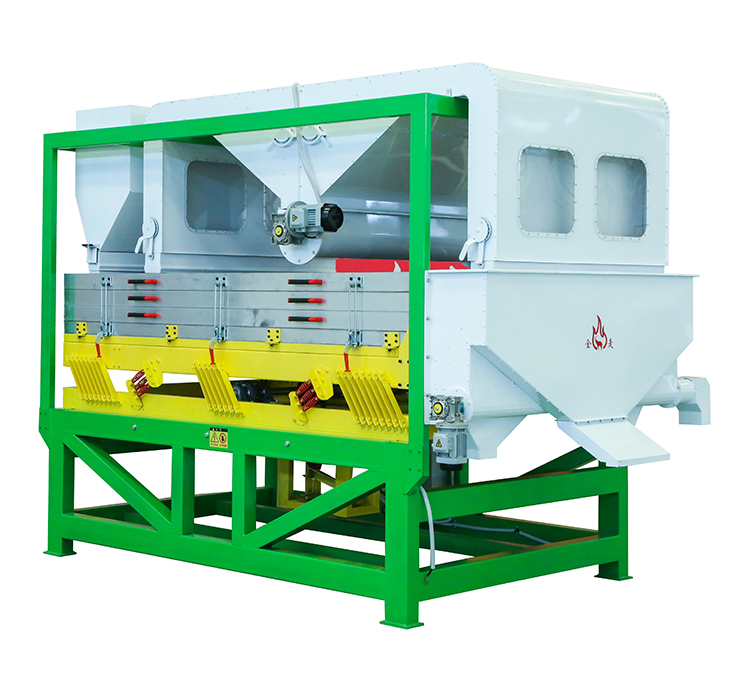
The pull rod impurity removal screen is a basic equipment for material initial processing and impurity removal operations, widely used in industries such as grain, feed, and agricultural and sideline products for material impurity removal. Its impurity removal efficiency and operational convenience are directly related to the effectiveness of material impurity removal and the efficiency of production operations. The equipment can handle various types of impurities for a long time, and needs to meet the cleaning needs of different impurity types and contents, while also taking into account the convenience of daily operation, cleaning, and maintenance. To ensure these two core performance, it is necessary to work together from three aspects: screen structure adaptation, pull rod transmission design, and optimization of vulnerable components, to comprehensively avoid problems such as incomplete impurity removal and operation lag, and ensure that the pull rod impurity removal screen can play a stable role in impurity removal in the long term, which is in line with the requirements. Requirements for impurity removal processing of various materials.
The adaptation of the sieve structure is the basis for ensuring the efficiency of impurity removal, and a sieve design that fits the characteristics of the material can improve the effectiveness of impurity separation. The aperture and number of layers of the sieve body should be adapted according to the particle size and impurity type of the material. The combination of single-layer or multi-layer sieves can achieve graded separation of impurities of different sizes. The material of the sieve should be wear-resistant and stretch resistant, which can withstand the continuous impact and friction of the material and is not easily damaged or deformed. The design of the inclination angle of the screen body is reasonable, which can allow the material to smoothly slide down under the action of gravity, while ensuring sufficient residence time of the material on the screen surface, so that impurities in the material can be fully separated through the screen mesh. The layout of the outlet of the screen body is in line with the cleaning process, so that the clean material and impurities after cleaning can be accurately discharged separately, avoiding mixing and improving the cleaning efficiency of the equipment from the structural level.
The design of the rod drive is the core link to ensure the efficiency of cleaning and the convenience of operation. A stable transmission structure can balance the vibration effect of the screen body and the operating experience. As the core transmission component of the equipment, the connection method and transmission stroke of the pull rod need to be matched with the screen body. The reciprocating motion of the pull rod can drive the screen body to form uniform and stable vibration, causing the material on the screen surface to constantly flip, increasing the probability of contact between impurities and the screen mesh, accelerating the separation speed of impurities, and avoiding material accumulation or incomplete cleaning caused by uneven vibration. The operating part of the pull rod is designed to conform to ergonomics, and the grip of the handle is comfortable. The force is evenly distributed during the pushing and pulling process, without any jamming or lag. Even if operated for a long time, fatigue is not easily generated. At the same time, the transmission structure of the pull rod is simple and easy to understand, and operators can quickly master the usage method without complex training, improving the convenience of operation.
Optimization of vulnerable components is an important guarantee for ensuring two major performances, and humanized component design can improve the user experience and maintenance efficiency of equipment. The vulnerable components of the equipment, such as the screen mesh, rod joint, and sealing gasket, are designed with modularity. Disassembly and replacement do not require complex tools, and operators can quickly complete the replacement and maintenance of components, reducing equipment downtime. The fixing method of the screen mesh is simple and firm, which can ensure that the screen mesh does not loosen or shift during vibration, and also facilitate daily cleaning and replacement. When meeting the cleaning needs of different materials, different aperture screens can be quickly replaced. The transmission part of the pull rod is equipped with wear-resistant protective covers to reduce component wear and extend service life. At the same time, reasonable maintenance space is reserved on the equipment body for operators to inspect, clean and maintain internal components, making daily maintenance of the equipment more convenient.
By adapting the screen structure that fits the material, designing a stable rod drive, and optimizing user-friendly vulnerable parts, the rod cleaning screen can effectively ensure the cleaning efficiency and ease of operation. It can quickly and thoroughly separate various impurities in the material, improve the purity of the material, and allow operators to easily complete the operation, cleaning, and maintenance of the equipment, thereby improving the efficiency of production operations. It is suitable for the initial processing and cleaning needs of various materials such as grain and agricultural products, and provides a high-quality raw material foundation for subsequent material processing.