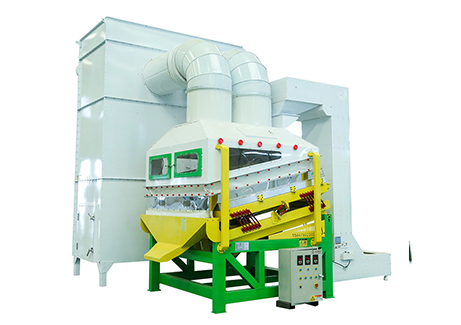
Various malfunctions may occur during the use of the stone removal machine. Here are some common troubleshooting methods:
1、 Poor material handling effect
Check material properties: The humidity, particle size distribution, and other characteristics of the material may affect the stone removal effect. If the humidity of the material is too high, it may cause the stones to adhere to the material, making it difficult to separate; Uneven particle size may also deteriorate the screening effect of the stone removal machine.
Check the condition of the screen surface: Check whether the screen surface is damaged, blocked, or severely worn. Damaged screening surfaces can cause material leakage and affect the stone removal effect; Blocked sieve holes can prevent materials from passing through normally, reducing screening efficiency; A severely worn screen surface may cause the size of the sieve holes to increase, resulting in incomplete separation of stones.
Adjusting air volume and wind speed: Air volume and wind speed are important factors affecting the effectiveness of the stone removal machine. If the air volume is too low to separate the stones from the material; If the air volume is too high, it may also blow away some materials, affecting the efficiency of stone removal. The air volume and speed can be adjusted by adjusting the speed of the fan or the opening of the air door to observe whether the stone removal effect has improved.
Check the working angle of the stone removal machine: The installation angle and working angle of the stone removal machine have an impact on the flow of materials and the separation of stones. Too large or too small an angle may cause the material to stay in the machine for an inappropriate time, affecting the stone removal effect. It should be adjusted to the appropriate working angle based on the characteristics of the material and the type of stone removal machine.
2、 Abnormal machine vibration
Check the basic installation: Check whether the foundation of the stone removal machine is firm and whether the anchor bolts are loose. If the foundation is not firm or the anchor bolts are loose, the machine will generate significant vibrations during operation. The anchor bolts should be tightened in a timely manner to reinforce the foundation.
Check the transmission components: Check whether the belt pulley, coupling and other transmission components are installed correctly, and whether there is any looseness, wear or eccentricity. Unbalanced or improperly installed transmission components can cause machine vibration. If there are any problems, the transmission components should be adjusted or replaced in a timely manner.
Check the exciter: The exciter is a key component that generates vibration. Check whether the internal components such as bearings and eccentric blocks are normal. Bearing damage, loose or worn eccentric blocks can all cause abnormal operation of the exciter, leading to abnormal vibration. If there is any damage, the relevant components should be replaced in a timely manner.
Check material distribution: Uneven distribution of materials inside the stone removal machine can also cause abnormal vibration. Check if the feeding device is functioning properly and ensure that the materials are evenly fed into the stone removal machine. If the material accumulates unevenly on the screen surface, the position or flow rate of the feed inlet can be adjusted to ensure even distribution of the material.
3、 Excessive noise
Check for loose components: During the operation of the machine, the connecting bolts, nuts, and other components may become loose, causing noise. Check and tighten all loose components, especially the connection parts of vibrating components.
Lubrication system inspection: Check the lubrication condition of each lubrication point to ensure that moving parts such as bearings and gears are well lubricated. Lack of lubrication can lead to increased component wear and noise. Timely supplement or replace lubricating grease and oil to ensure the normal operation of the lubrication system.
Inspect worn parts: check the wear condition of easily worn parts such as the screen surface, exciter, and transmission components. Severely worn components can generate noise during operation and should be replaced promptly.
Cleaning the interior of the machine: There may be residual materials or debris inside the machine, which can cause collision noise during operation. Regularly clean the residual materials and debris inside the stone removal machine to maintain its cleanliness.
4、 Blockage of discharge outlet
Check the size of the discharge port: The size of the discharge port should be designed reasonably according to the particle size and output of the material. If the size of the discharge port is too small, it is easy to cause material blockage. The size of the discharge port can be appropriately expanded according to the actual situation.
Observe the flow status of materials: Check the flow status of materials in the stone removal machine, whether there is material accumulation or poor flow. If materials accumulate in a certain area, it may cause blockage of the discharge port. The flow direction of materials can be adjusted or the flowability of materials can be improved, such as adding flow aids.
Cleaning the discharge port: Regularly clean the material residue and clumps at the discharge port to prevent them from blocking the discharge port. For materials with high viscosity, heating or humidification methods can be used to reduce the viscosity of the material and avoid clumping and blockage.
When troubleshooting, the principle of starting with the easy and then the difficult, and starting with the outside and then the inside should be followed to gradually inspect each component and system, accurately identify the cause of the fault, and promptly eliminate it to ensure the normal operation of the stone removal machine.