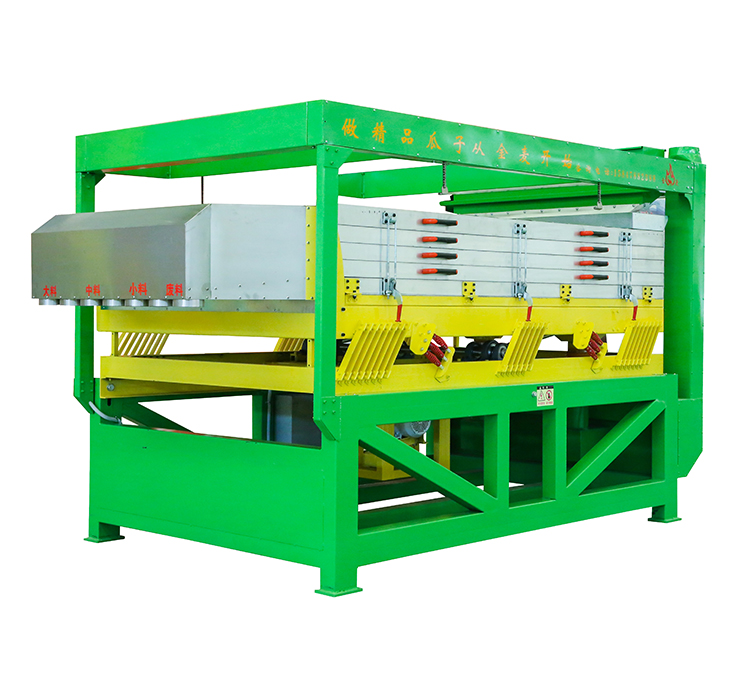
The working principle of a pull rod vibrating screen (usually referred to as a vibrating screen) is mainly based on inertial vibration and resonance effects. The following is a detailed explanation of its working principle:
1、 Core components and their functions
1. Exciter: The exciter is the core component of the vibrating screen, which generates periodic centrifugal force through rotation. This centrifugal force is the main source of power for the vibration of the vibrating screen. The exciter is usually composed of a motor and an eccentric block. When the motor starts, the eccentric block rotates to generate centrifugal force, forcing the sieve box to vibrate.
2. Screening box: The screening box is the working body of the vibrating screen, used to carry materials and screen them. The sieve box is usually welded from steel plates and steel sections, or connected by high-strength bolts, with a mesh or sieve plate fixed inside.
3. Elastic elements (springs): The main function of elastic elements (such as isolation springs, main vibration springs, and connecting rod springs) is to support the vibrating body, enable the body to achieve the required vibration, and reduce the dynamic load transmitted to the foundation or structural frame. These springs help reduce the impact of vibration on the ground and improve the quality and lifespan of the vibrating screen.
2、 Working principle
1. Excitation force generation: When the motor drives the exciter to rotate, the centrifugal force generated by the eccentric block is transmitted to the sieve box through the tension rod, causing the sieve box to form a three-dimensional vibration trajectory (such as circular, straight or elliptical) at a specific frequency. This vibration trajectory causes the material to undergo a jumping motion on the screen surface, thereby achieving screening.
2. Material layering and screening: Under the action of vibration, the material undergoes a jumping motion on the screen surface. Large particles are trapped in the top layer of the sieve due to insufficient kinetic energy, while small particles pass through the sieve holes to complete the screening. This layering phenomenon improves the screening efficiency.
3. Anti blocking net design: High frequency vibration not only helps with material screening, but also allows materials stuck in the sieve holes to bounce up, thereby maintaining screening efficiency. This design reduces the clogging of the screen mesh and improves the stability and reliability of the vibrating screen.
3、 Motion trajectory and screening effect
The vibrating screen vibrates along different trajectories, causing the material to move along the working surface and undergo screening. When the vibrating screen adopts different kinematic parameters, the material moves along different trajectories. Common forms of material motion include relative stillness, forward sliding, reverse motion, and throwing motion. These forms of motion contribute to the uniform distribution and efficient screening of materials on the screen surface.
In summary, the working principle of the rod vibration screen is based on inertial vibration and resonance effects. The periodic centrifugal force generated by the exciter forces the screen box to vibrate, thereby achieving material screening. This screening method has the advantages of high efficiency, stability, and reliability, and has been widely used in industrial production.