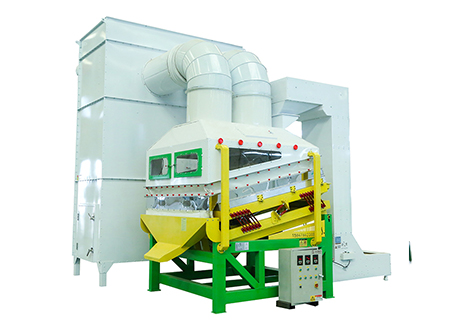
The abnormal screening surface of the stone removal machine may be caused by five major factors: material characteristics, equipment parameters, mechanical structure, airflow distribution, and operation and maintenance. The specific reasons and analysis are as follows:
1、 Material characteristic issues
1. Excessive humidity
Excessive moisture content in materials can cause stones to adhere to grains, increase screen resistance, and prevent effective separation of stones. For example, when the moisture content of rice exceeds 15%, the sieve surface is prone to clumping and needs to be dried to reduce moisture.
2. Uneven granularity
Excessive differences in material particle size can disrupt the uniformity of the sieve surface. Particles that are too large may clog the sieve holes, while those that are too small are easily blown through by airflow, leading to ineffective grading. The sieve size needs to be adjusted according to the material characteristics (such as 2-5mm).
2、 Improper device parameter settings
1. Imbalance between flow and air volume
Excessive flow: If the material layer is too thick (over 50mm), it will hinder the penetration of airflow and reduce the efficiency of stone removal.
Low air volume: Insufficient static pressure of the airflow (below 1.2m/s), unable to suspend and classify the material.
Excessive airflow: The airflow blows through the material layer, causing stones and grains to mix and be discharged.
Solution: Control the flow rate between 35-75kg/cm · h and the wind speed between 1.2-1.3m/s by adjusting the main air door and feed valve.
2. Abnormal inclination angle of screen surface
Excessive inclination angle (over 10 °): The material flows too quickly, and the stones are discharged before fully contacting the screen surface.
Too small inclination angle (less than 5 °): Material accumulation and excessive screen load.
Solution: Adjust the height of the front support rod of the screen body to maintain the inclination angle at around 7 °.
3、 Mechanical structural failure
1. Damaged or blocked screen surface
The wear of the sieve results in an increase in pore size and incomplete separation of stones.
Blockage of sieve holes (such as dust and fiber impurities) can reduce screening efficiency.
Solution: Regularly check the screen surface, replace worn screens (recommended to check every 3 months), and clean blockages.
2. Abnormal vibration system
Asynchronous vibration motor: Two motors rotate in opposite directions but have different phases, resulting in irregular vibration of the screen body.
Spring damage: Rubber springs aging or breaking, affecting amplitude stability.
Bearing wear: Rolling bearings or rubber bearings are damaged, resulting in jolting and twisting phenomena.
Solution: Correct the motor phase, replace the spring and bearing, and ensure that the amplitude is within the range of 3.5-5mm.
3. Issues with suspension rods and air deflectors
Inconsistent specifications of suspension rods: The four suspension rods have different lengths or inclinations, resulting in a deviation in the trajectory of the screen body movement.
Deformation of the air guide plate: The rack of the air guide plate is skewed, causing uneven air flow on both sides of the screen surface.
Solution: Correct the length and inclination of the suspension rod, repair or replace the air guide plate.
4、 Uneven distribution of airflow
1. Fan position offset
The fan casing is offset relative to the impeller, resulting in inconsistent angles between the air guide plate and the top of the impeller, causing uneven horizontal airflow on the screen surface (higher in the middle and lower on both sides).
Solution: Adjust the position of the fan to ensure the correct angle of the air guide plate.
2. Excessive reverse airflow
The reverse airflow velocity in the selection room is too high (exceeding 11m/s), which makes it difficult for stones to be discharged; If it is too low (less than 10m/s), there will be too much grain in the stone.
Solution: Control the reverse airflow velocity by adjusting the curved plate of the selection chamber and the pressure door of the stone outlet.
5、 Improper operation and maintenance
1. Uneven feeding
Uneven feeding along the width direction of the screen surface leads to material deviation or accumulation.
Solution: Adjust the pressure valve or feeding direction of the material pipe to ensure uniform feeding.
2. Insufficient cleaning and maintenance
The residual material on the screen surface was not cleaned up in a timely manner, resulting in clumping and blockage.
Dust accumulation on the fan impeller reduces the stability of air flow.
Solution: Clean the screen surface and fan daily, and regularly check the equipment fasteners (such as anchor bolts and locking nuts).