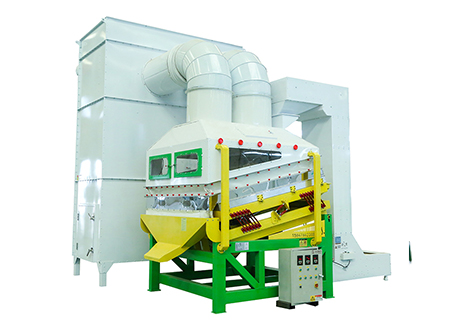
The method of adjusting the parameters of the stone removal machine based on material characteristics is as follows:
1、 Moisture content and surface characteristics of raw materials
The moisture content of raw materials directly affects the friction coefficient of materials. The increase in friction force of high moisture raw materials can easily lead to a slower flow velocity on the screen surface, affecting the stratification effect. At this time, it is necessary to strengthen the vibration conditions of the screen surface appropriately, such as increasing the amplitude or adjusting the position of the vibration motor's weight block, while reducing the inclination angle of the screen surface to a reasonable range (usually 10 °~13 °), and reducing the incoming flow rate to maintain a stable stone removal effect. For materials with smooth surfaces, it is necessary to reduce the mesh size or use fish scale mesh screens to enhance the adsorption force and prevent the material from being blown through prematurely by the airflow.
2、 Particle size uniformity and impurity types
When there is a significant difference in material particle size, large particles are prone to clogging the sieve holes, while small particles may directly penetrate the sieve. In response to such situations, it is necessary to adjust the configuration of the grading screen according to the characteristics of impurities: if the particle size of impurities such as shoulder stones is close to that of the material, the two sections of 6 × 20 elongated sieve holes in the grading screen can be replaced with d8 sieve holes, and the screening accuracy can be enhanced by reducing the size of the sieve holes; If the particle size of impurities is significantly smaller than that of the material, it is necessary to clean the blockages in the sieve holes. If necessary, a double-layer sieve structure should be used, with the upper layer screening large impurities and the lower layer separating small impurities. For materials containing flexible impurities (such as small impurities with awns and spikes), the air flow should be reduced to the lower limit of the design wind speed (usually 1.0-1.3m/s) to avoid uneven air flow distribution leading to delamination failure.
3、 Material flow rate and layer thickness
Flow control must strictly match the rated output of the equipment. When the flow rate is too high, the thickness of the material layer exceeds the bearing capacity of the screen surface (usually the feeding amount does not exceed ± 10% of the rated output), which will cause the material to be unable to form a suspended state and the separation of stones and wheat grains to be incomplete. At this time, the feeding speed should be reduced by adjusting the feeding pressure valve or frequency converter, while observing the movement of the material on the screen surface to ensure that the material layer is in a wavy "boiling" motion and the lower material surface reaches half of the transparent observation window position. If the flow rate is too small, it is easy to cause airflow to penetrate the material layer. It is necessary to increase the opening of the air door or increase the fan speed to supplement the air volume and maintain a stable air velocity on the screen surface.
4、 Screen structure and vibration parameters
For different material characteristics, it is necessary to adjust the screen surface characteristic parameters accordingly: for fragile materials, the screen surface inclination angle should be controlled between 10 ° and 11 ° to reduce the material sliding speed; For high-density impurities, it is necessary to increase the shrinkage angle of the sieve surface to a reasonable range (usually 5 °~8 °) to enhance the agglomeration effect. The adjustment of vibration parameters needs to be carried out synchronously. By observing the motion trajectory of the screen body through the vibration indicator disk, when the amplitude error on both sides exceeds 0.5mm, the phase angle of the vibration motor's weight block needs to be adjusted to be completely consistent; If the vibration angle deviates from the design value (usually 35 °~45 °), the fixing bolts of the motor need to be loosened for angle correction to ensure that the vibration direction of the screen surface cooperates with the direction of material movement.